Here are 10 of the most Captivating and Bretahtaking Deserts! From the Sahara, the worlds largest to the Farafra in Egypt and even the Taklamakan, a desert covered with snowfall! Taklamakan (Central Asia): a desert covered with snowfall Taklamakan is one of the largest sandy deserts in the world, ranking 15th in size in a ranking of the world's largest non-polar deserts. It covers an area of 270,000 km2 (100,000 sq mi) of the Tarim Basin, 1,000 kilometres (620 mi) long and 400 kilometres (250 mi) wide. It is crossed at its northern and at its southern edges by two branches of the Silk Road as travelers sought to avoid the arid wasteland. It seems incredible, but in a country that keeps around 30% of the fresh water and shelters the largest rain forest in the world, we can find a “desert”. Located in the State of Maranhão, on the north shore of Brazil, the Lençóis Maranhenses National Park is an area of about 300 square kilometers (155,000 ha) of blinding white dunes and deep blue lagoons, forming one of the most beautiful and unique places in the world. The dunes invade the continent over 50km (31 miles) from the cost, creating a landscape that reminds a white bed sheet, when seen from above. The Salar is one of the iconic images of Bolivia, a massive salt desert in the middle of the Altiplano. It is an expansive, virtually flat desert that reflects the sun in such a way as to create a mirror effect with the sky. There are several lakes in the desert with strange colours from the mineral deposits in the region. South of Africa lies the Namib desert. which is less vast than the Sahara but just as impressive. It forms part of the Namib-Naukluft National Park with neighbouring Angola. The Sossusvlei sand dunes are the highest in the world, some towering at 300m high and if you are lucky enough, you can stumble across desert elephants-the Namib is the only desert in the world to have elephants. Apparently the oldest desert in the world, myriad species of plants and animals can only be found here. The Namib has fascinated geologists for years but it remains very little understood to this day. Off the coast, strong southerly winds with fogs and strong currents cause sailors to lose their way; the north coast has been named 'Skeleton Coast' due to the amount of shipwrecks found there, some of which can be found as much as 50m inland, as the desert slowly takes over the ocean as it moves westwards. Australia is home to four large deserts, popularized by Mad Max: Sturt's Stoney Desert, Tanami Desert, the Great Victoria Desert and the Simpson Desert, which is also known as 'The Big Red' due to the presence of dunes of red sand. The Simpson Desert is an erg which contains the world's longest parallel sand dunes. These north-south oriented dunes are static, held in position by vegetation. They vary in height from 3 metres in the west to around 30 metres on the eastern side. The most famous dune, Nappanerica, or, more popularly, Big Red (named by Simpson Desert traveller Dennis Bartell), is 40 metres in height. Antarctica is a land of extremes. It's not inhabited year round by humans because it's simply too freezing cold. In 1983 scientists recorded extreme cold temperatures as low as -129 Fahrenheit. It's also the wettest place on Earth, but simultaneously the driest. The reason it's the “wettest” is not because of rainfall; since Antarctica is covered by 98% ice, it's technically very wet. However since it's also the aforementioned coldest place in the world, it gets very little precipitation – less than 2 inches a year. Which makes Antarctica a desert. A brutally cold ice desert with a massive trench full of even more…ice. Three for the price of one! Sahara (North Africa): world's largest desert The Sahara, with a size of 8.6 million km², is the world's largest desert, covering large parts of North Africa. Around 4 million people live there. Its maximum length is 4,800 km, running from west to east, and up to 1,200 km from north to south. Sahara covers most of Mauritania, Western Sahara, Algeria, Libya, Egypt, Sudan, Chad, Niger and Mali, and touches Morocco and Tunisia.
In 2008, China's biggest desert experienced its biggest snowfall and lowest temperature after 11 consecutive days of snow. Snow is rare in the desert that covered 337,600 square kilometers, never before had the whole desert been covered.
Lençóis Maranhenses (Brazil): a ‘desert' with lagoons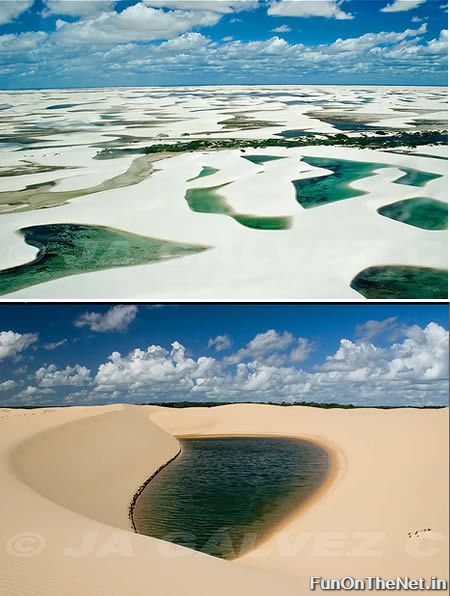
But you may ask: -Lagoons?? You told me it was a desert… Yes, what defers this region from a desert is the amount of rain that drops over the dunes, creating ponds of crystal clear water on the depression between dunes. Despite its desert-like appearance, Lençóis Maranhenses records an annual rainfall of 1,600mm (i.e. 62.9 inches), 300 times more than in the Sahara. During the period of drought, the lagoons evaporate and become completely dried. After the rainy season, the lagoons are home of many species of fish, turtles and clams. The mystery in this story lies in the fact that when the lagoons fill up, life comes back, as if they had never left the place. One of the hypotheses to explain the phenomenon is that the eggs of the fish and crabs are maintained alive in the sand, exploding when rain comes back.
Salar de Uyuni (Bolivia): the world's largest salt desert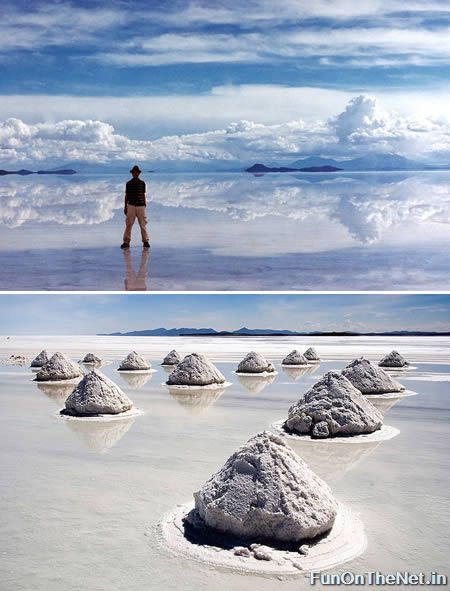
Some 40,000 years ago, the area was part of Lake Minchin, a giant prehistoric lake. When the lake dried, it left behind two modern lakes, Poopó Lake and Uru Uru Lake, and two major salt deserts, Salar de Coipasa and the larger Uyuni. Uyuni is roughly 25 times the size of the Bonneville Salt Flats in the United States. It is estimated to contain 10 billion tons of salt, from which less than 25,000 tons is extracted annually.
Farafra (Egypt): the white desert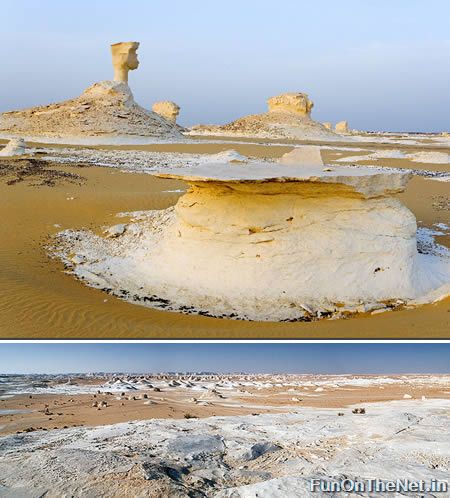
A main geographic attraction of Farafra is its White Desert (known as 'Sahara el Beyda,' with the word 'sahara' meaning a desert). The White Desert of Egypt is located 45 km (30 miles) north of Farafra. The desert has a white, cream color (it is truly white, in clear contrast with the yellow deserts elsewhere) and has massive chalk rock formations that have been created as a result of occasional sandstorms in the area.
Atacama (Chile): the flourished desert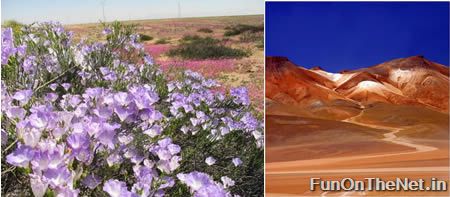
The Atacama Desert occupies the largest amount of the Chilean territory located north of the 29th parallel. The area located on the coast between Arica and Antofagasta appears in the Guinness Book of World Records as the driest place in the world. Nevertheless, to the south of the Tropic of Capricorn, the desert becomes kinder towards living beings. The coastal mists, "camanchacas", are more abundant south of Antofagasta and bring the humidity necessary for the maintenance of the coastal scenic vegetation. Many plants survive mainly because of the "camanchaca", and the harsh savings of water, in normal dry years, that causes them to delay important functions such as growth, to favor survival and reproduction. (Link)
Namib (Namibia): the only desert with elephants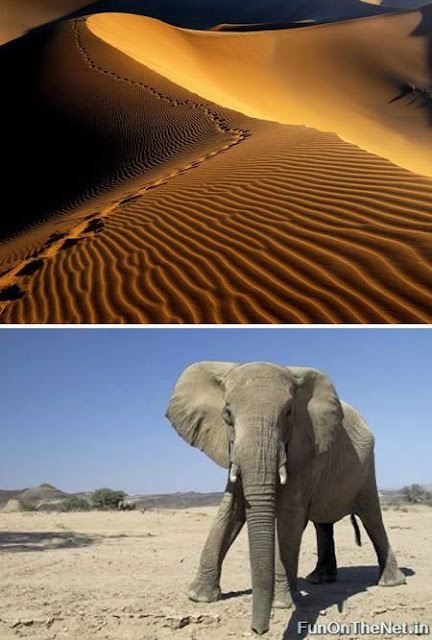
Simpson Desert (Australia): the red sand desert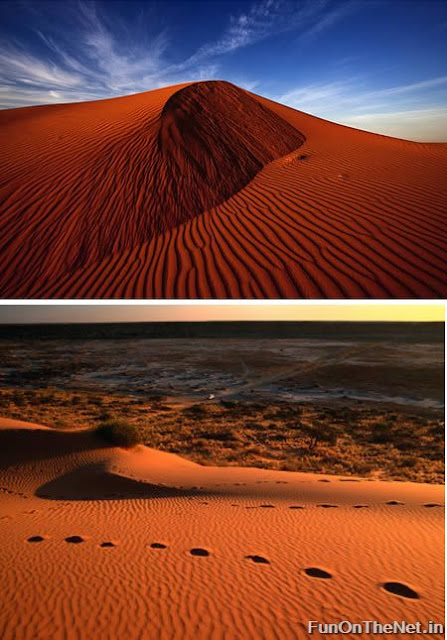
The Black Desert (Egypt): the desert with black stones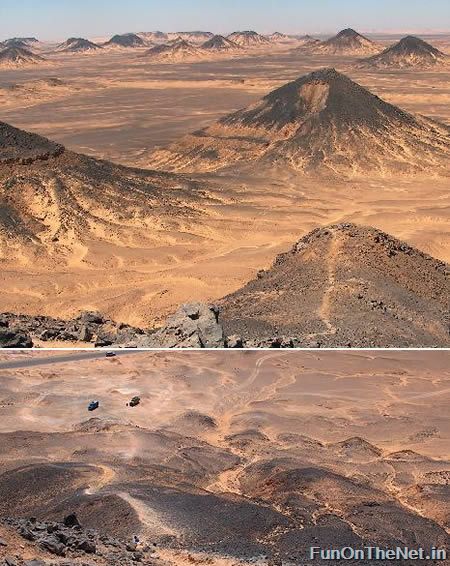
Located 100km northeast of the White desert, the Black Desert is a region of volcano-shaped mountains with large quantities of small black stones. The stones lie out across the orange-brown ground, so that it is not quite as black as many people may hope for. Especially after visiting the White Desert, which has formations that are really white, many will imagine a desert as dramatic as this. Climbing one of the many soft peeks, the view from the top is really nice, with similar peeks continuing on into the haze. The Black Desert is uninhabited. (Link)
Antarctica: world's driest and wettest desert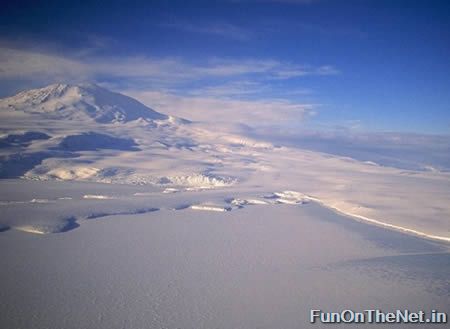
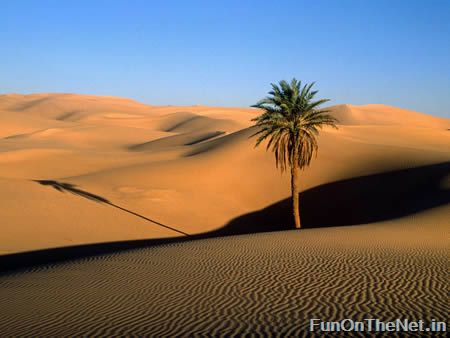
Sahara is very dry but there is an annual rainfall in most regions, although just a few dozen millimetres.
10 Most Captivating Deserts

DUMB INVENTIONS

Curved Barrel Machine Gun, 1953
The 20th century saw many astounding technological innovations. The automobile revolutionized the way people live and work, the internet changed the way people think about information, and the U.S. of A put a man on the moon. But some technological advances that came in the earlier part of the 20th centry weren't exactly meant for the history books. Because they were stupid. Take, for example, this M3 sub-machine gun with a curved barrel for shooting around corners. It's the perfect gun for the "shoot first, look where you're shooting later" kind of guy.
Photo: Keystone/Getty Images
Jan 12, 1952

Anti-Bandit Bag, 1963
Inventor John H T Rinfret demonstrates his anti-bandit bag. To foil thieves the chain is pulled and the bottom of the case falls out so the contents are scattered over the floor. That'll stop those thieves from getting at the contents of your bag! No, wait. It won't.
Photo: Fred Mott/Getty Images
Aug 27, 1963

Hubbard Electrometer, 1968

Cup Bras, 1949
Charles L. Langs poses with his strapless, backless, wireless, support-less bras. His wife is justifiably dubious.
Photo: Nina Leen/Time Life Pictures/Getty Images
May 01, 1949

Finnish Portable Sauna, 1962 Photo: Yale Joel/Time Life Pictures/Getty Images

Baby Cage, 1937
A nanny supervising a baby suspended in a wire cage attached to the outside of a high tenement block window. The cages were distributed to members of the Chelsea Baby Club in London who have no gardens, or qualms about putting a child in a box dangling over a busy street.
Photo: Reg Speller/Getty Images
Jun 23, 1937

Laryngaphone, 1929
Photo: S. R. Gaiger/Getty Images
Sep 11, 1929

Motorized Surfboard, 1948
Hollywood inventor Joe Gilpin riding his motorized surfboard.
Photo: Peter Stackpole./Time Life Pictures/Getty Images
Apr 01, 1948

Rainy Day Cigarette Holder, 1954
Photo: YALE JOEL
Mar 01, 1954

Rocket Belt, 1961
Engineer Harold Graham salutes President Kennedy after demonstrating Rocket Belt for him.
Photo: John Loengard./Time Life Pictures/Getty Images
Jan 01, 1961

Honegar, 1959
Photo: Fritz Goro./Time Life Pictures/Getty Images
Dec 01, 1959

Illuminated Tires, 1961
A woman adjusts her stocking by the light of the Goodyear's illuminated tires. The tire is made from a single piece of synthetic rubber and is brightly lit by bulbs mounted inside the wheel rim.
Photo: Douglas Miller/Getty Images
Oct 16, 1961

Shower Hood, 1970
Photo: Keystone/Getty Images
Feb 12, 1970

Cigarette Pack Holder, 1955 Photo: Jacobsen/Getty Images
Jan 01, 1955

Fast-Draw Robot, 1960
Photo: J. R. Eyerman./Time Life Pictures/Getty Images
Jun 01, 1960

 The workstation can increase energy expenditure |
The designers, the Mayo Clinic in Minnesota, said it could help obese people to lose up to 30kg a year.
Fifteen obese volunteers burned an average of 191 calories an hour using the treadmill, compared to 72 calories just sitting at their desk.
The study features in the British Journal of Sports Medicine.


Lucozade Sports Science Academy


The workstation, which is designed to be used for two to three hours a day, comprises a computer, keyboard and treadmill.
The steel frame of the device is shaped in the form of the letter "H" and is supported by four locking rubber wheels, so that it can be moved about easily.
The frame holds a Plexiglass panel on to which two adjustable arms are bolted - one to hold the computer screen and the other for the keyboard and mouse.
Slats provide storage for personal items such as flower vase, cup holder, pen holder or paper tray.
The adjustable design enables users to walk and work, stand and work, or, if the treadmill is replaced by a high chair, sit and work. The speed of the treadmill can also be adjusted by the user.
Sedentary jobs
The 14 men and one women who took part in the trials all had sedentary office jobs, and none took part in any regular exercise.
While using the workstation, they walked at the equivalent of one mile an hour.
Their energy expenditure while using the workstation for 35 minutes every hour was compared to that while working at their desk.
The researchers said: "If sitting computer time were replaced by walking-and-working, energy expenditure could increase by 100 kcal (calories) per hour.
"Thus, if obese individuals were to replace time spent sitting at the computer with walking computer time by two to three hours a day, and if other components of energy balance were constant, a weight loss of 20-30 kilograms per year could occur."
Obesity rates are soaring across much of the developed world, and many people blame a hectic lifestyle for failing to make time to exercise.
An increase in sedentary leisure activities, such as using a computer, has also been blamed.
More than 12m adults and one million children in England alone will be obese by 2010 if no action is taken, a report by the Department of Health predicted last year.
John Brewer, director of the Lucozade Sports Science Academy, said: "The growing obesity epidemic is something that requires drastic action.
"This is clearly this is something that is slightly gimmicky and unusual, but if it is a way of getting people with sedentary lifestyles off of their backsides then that has got to be a good thing."
Mr Brewer said the workstation could potentially appeal to people who found pounding out miles on a treadmill tedious by allowing them to combine it with a more interesting activity.
The desks cost £1,000 each.


